









Before four-thirty every morning, Katharina wakes to the sound of embers crackling in the oven. She keeps a small clock on the writing table in her bedroom but doesn’t need it. She always waits in bed, listening to the oven, counting down to the moment when the alarm will go off. She understands its mighty inferno into which she pushes her tins filled with batter every Friday night before going to bed; she understands it as well as she knows her reasons for being in her house in the Fort and for making her living the way she does.
The oven’s fire always says one thing to her: “Katharina, you must learn to trust me. Once you have given your cakes to me, you must believe that I will do my work. You can’t direct a fire.”
The flames roar under the oven like a wildfire in a drought-ridden forest, and by the time she places her cakes on its floor, the walls are ready to crack from the heat. Katharina hates that moment and the orders the flames give her. She knows she has no control over fire, and that as she sleeps, the oven and the flames will decide what she will find inside in the morning. Twenty plump, moist cakes, oozing nectar, redolent with the aroma of spices, or twenty dry, brittle rusks. A heap of crumbs good only to be scattered to the seagulls that hover outside her window.
It is the embers she looks forward to hearing. Every morning as she lies in bed waiting for the alarm to go off, the embers’ quiet pops and snaps say to her: “Katharina, a fire never lasts. It will die down, and in that dying heat, you will find that anything you love can be turned into a gift.”
As she drifts in and out of slumber and wakefulness, listening to the sounds in the house, she is lulled by the waves crashing against the ramparts. She descends into a deep listening to murmurings that speak to her about cakes and life and leaving behind a past. She hears the soft bursts of embers and smiles to herself. Soon they will be out, she tells herself.
She turns towards the wall, reaches out and touches its cool, cemented surface. Why didn’t I come earlier to this life? To this house?
When the alarm goes off at four-thirty, faint streaks of morning light are making their way in through the five windows in her room. Katharina gets up, wraps herself in a thick woollen shawl and goes barefoot to the oven and puts her hand in. She feels the heat rising from the oven floor and it is just right for this time of day. Heaving a sigh of relief, she then presses the top of one of the cakes and feels its surface spring to her touch. With a long wooden paddle, she takes the cakes out, one by one, and transfers them to the cooling cupboard at the end of the passage. After five days and six nights they will be ready to travel on their journey from the Fort to the mainland post office. From the city airport to London/Düsseldorf/Florence/Paris. From delicatessen to sweet-tooth-bearer.
This Saturday, twenty cakes, nestling inside octagonal tins decorated with motifs of custard-coloured vanilla flowers, bulging cashew apples and drooping coconut fronds, and labelled “Island Fort Love Cake”, leave the house with Katharina in her 1971 dark-green Beetle.
She drags the small wooden crate packed with cakes down the steps of the house and hauls it onto the back seat of the car through the passenger-seat door. All her neighbours watch as she struggles with the crate. But no one comes out to help her. The crate sits, angled off the back seat, balanced on the edge, with the cakes nestling inside paper padding, ready for their long journey.
Watching Katharina from behind the latticed wall of the veranda, Sheila says, as she does every Saturday: “There she goes with her cakes. Not a crumb for us but must be making millions. London–Milan–Paris. Only good for big shots, nothing for us.”
Katharina drives out, her Beetle humming down the road, speeding past the ramparts and whirring over the sound of the waves. She keeps the triangular window flaps of the Beetle open and the sea air sweeps into the car from one side and flows out the other, plastering her hair against her face. Katharina’s eyes sparkle with a light that would kill her neighbours to see. The rampart road of the Fort goes past the lighthouse. She stops at the lighthouse and honks.
“I need more pods. More cinnamon. More sugar. More of everything, Sudesh,” she says to the man who walks out of the lighthouse, handing him a small parcel wrapped in oil paper.
“How soon, missie?”
“Well, for next Friday I am OK. After that, it will be a problem.”
“There is a curfew in the city. But I will try, missie.”
“Why a curfew? Anyway, Sudesh, I need the ingredients. Don’t forget: no cake in the oven, no cake for you.” She grins and he returns a wide, toothless smile.
“Just like your grandmother, missie. She used to say, ‘Sudesh, you go out and pick up the vanilla from the vine and you clean the cashew. How am I to feed you without money from this cake?’”
“If you don’t find me the ingredients, I will be worse off than my grandmother. She had enough money to pay for you and all her workers. I don’t.”
“Missie, in the end, she didn’t have money. When your father went to England, no one came to buy the cake, missie. People said she was trying to poison them, like her son. Because your father fought the government. So she got me this job. Got the lighthouse keeper to take me as his gofer.”
And now no longer the gofer but the lighthouse keeper. Still, who needs a lighthouse in this day and age? This whole place is an anachronism, Katharina thinks.
Katharina looks at the face of the small, thin man who holds on to her car hood as he speaks. He is wearing a linen tunic, spattered with soot, but his hands are clean, fingers long and slender.
Still nimble and deft enough to clean the lighthouse panes and the lens. But for how long? How much longer can he do this? He will die of pneumonia in that gallery one day.
“She never let anyone help her.”
“All right, missie. No need to talk about these things. You give these cakes to the post office. I will try to get the ingredients for your next batch, missie.”
Katharina drives on. She turns off the rampart road onto the causeway that connects the Fort to the mainland. The Fort ends at the old church grounds that the government yoghurt company now uses as a grazing field. The causeway is Katharina’s favourite part of the drive. All around her the seawater is still because the seaboard is deep, layered with rocks that for centuries have protected the Fort from invasions. An early-morning mist gives the mainland in the distance and the expanse of water around her a mellow grey sheen. Three fishermen row towards the Fort on their dugout canoes; the sound of the oars hitting the water rises out of the mist in muffled thuds.
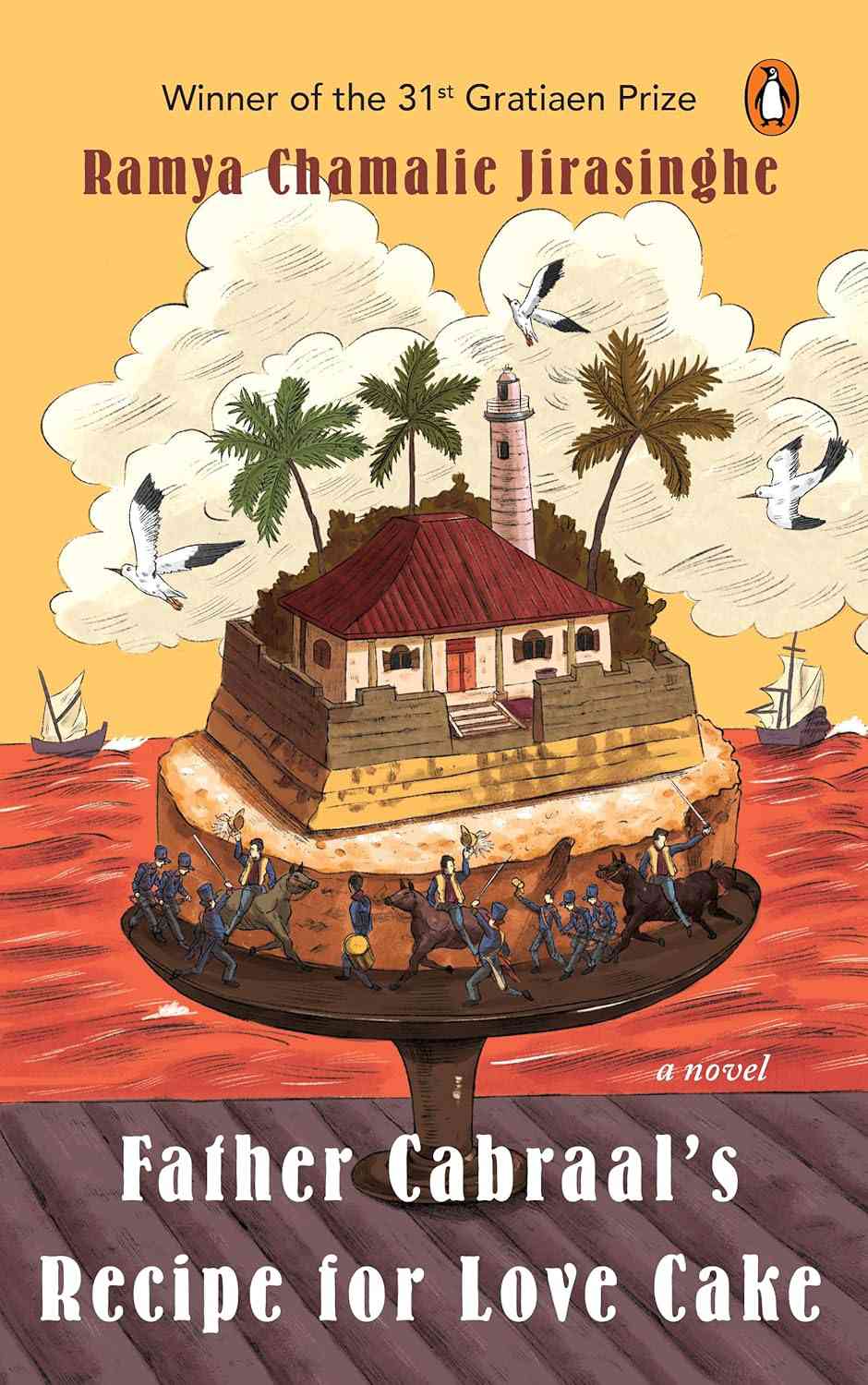
Excerpted with permission from Father Cabraal’s Recipe for Love Cake, Ramya Chamalie Jirasinghe, Penguin India.
